Alzheimer’s disease (AD) is characterized by cerebral accumulation of amyloid beta (Aβ) associated with neuronal degeneration. Aβ is a peptide with a strong tendency to form aggregates and is generated through the processing of the amyloid precursor protein (APP). APP is a central protein in AD, as it represents the only source of Aβ and can also act as a receptor for Aβ species, thereby contributing to neuronal degeneration.
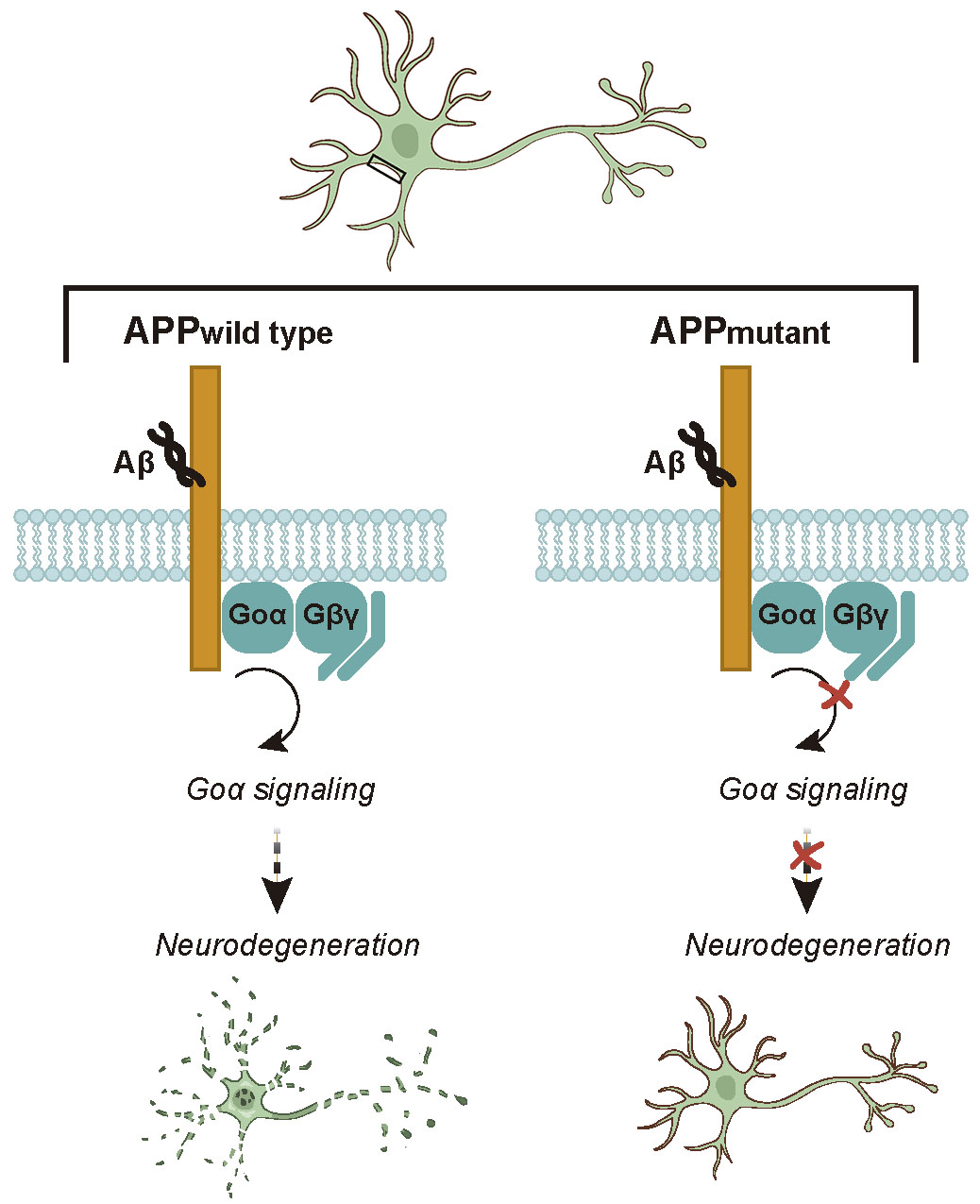
Our research focuses on understanding the mechanisms by which Aβ induces neurodegeneration, with particular emphasis on the role of APP as a receptor and on the involvement of the heterotrimeric G protein Go as a pathological signaling pathway. To address this, we employ approaches that combine advanced microscopy, cellular, molecular, and biochemical techniques, together with human neuronal models derived from induced pluripotent stem cells.
In particular, we aim to identify genetic variants of APP that modulate Go-mediated signaling and confer protective effects against Aβ toxicity. Our studies seek to determine the potential of this signaling pathway as a molecular target for the development of new therapeutic strategies for AD.
COMPETITIVE RESEARCH FUNDS
- 2022-2025. AARGD-22-926476, Alzheimer’s Association (Co-PI)
- 2019-2023. PICT2018-02097, FONCyT (PI)
- 2018-2022. SECyT-UNC (PI)
- 2015-201. PICT2014-3155, FONCyT (PI)
- 2014-2017. PBIT-261/14, FORNASEC (Co-PI)
- 2011-2014. PICT-1895, FONCyT (PI)
- 2011-2013, PIP CONICET (PI)
- 2010-2011. SECyT-UNC (PI)
- 2008-2010. PICT#06-01941, FONCyT (PI)
- 2006-2007. PIP del CONICET (PI)
- 2006. PME0497-02, ANPCyT (PI)
- 2004-2006. PICT#5-14291, FONCyT (PI)
- 2001-2003. Fundación Antorchas (PI)
- 2000-2004. PICT# 5-7329, FONCyT (PI)
- 1998-1999. PICT# 05-0236C, FONCyT (PI)
PUBLICATIONS (LATEST FIVE YEARS)
- Dargam S, de Olmos S, Pautassi MR, Lorenzo A (2024). Footshock drives long-lasting remodeling of perineuronal nets in retrosplenial cortex during contextual fear memory formation. Neurobiol. Learn Mem, November 2024, 107990. https://doi.org/10.1016/j.nlm.2024.107990
- de Olmos S and Lorenzo A. Developing the theory of the extended amygdala with the use of the cupric-silver technique. Journal of the History of the Neurosciences (NJHN)- DOI: 10.1080/0964704X.2022.2133569
- Antonino M, Marmo P, Freites CL, Quassollo G, Sanchez MF, Lorenzo A*, Bignante EA* (2022) Aβ promotes amyloidogenic processing of APP and intracellular accumulation of Aβ42 through Go/Gβγ signaling. Front Cell Develop Biol, april 22, vol 10, art 852738, https://doi.org/10.3389/fcell.2022.852738 (IF2021-22: 6.68)
- Magdalena Antonino, Paula Marmo, Carlos Leandro Freites, Gonzalo Quassollo, Maria Florencia Sanchez, Alfredo Lorenzo*, Elena Anahí Bignante* (2021). Aβ promotes amyloidogenic processing of APP through a Go/Gβγ signaling. bioRxiv https://doi.org/10.1101/2021.03.10.434768 (una versión modificada de este trabajo se publicó posteriormente en Front Cell Develop Biol)
- Sigwald EL, de Olmos S, Lorenzo A. (2020) Retrograde and anterograde contextual fear amnesia induced by selective elimination of layer IV-Va neurons in the granular retrosplenial cortex (A29). Neurobiol. Learn Mem 2020 Apr 11:107229. doi: 10.1016/j.nlm.2020.107229
- Complete and updated list available here.