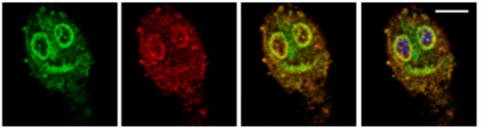
A characteristic of parasitic microorganisms is their ability to quickly adapt to changes in the environment, characterized by the presence of various adaptation mechanisms to different environmental conditions. Giardia lamblia constitutes an interesting study model due to its medical importance as a causative agent of giardiasis and its biological significance in understanding higher eukaryotic organisms, given its status as an ancestral eukaryote.
Surviving and differentiating within a potentially hostile environment are key actions in Giardia’s life cycle to remain in its host and thereby ensure the continuity of its species. Surviving in the intestinal environment involves, among other things, adhering to the intestinal epithelium and evading the host’s immune response. On the other hand, differentiation into its infective form (the cyst) requires significant changes in cellular structure and complex regulation at the genetic and protein levels.
The overall goal of our laboratory is to explore how post-translational modifications of proteins participate in regulating these basic processes involved in the survival of Giardia lamblia. Specifically, in recent years, we have focused on post-translational modifications of histones (citrullination, methylation, and acetylation) and the study of enzymes and functions associated with these epigenetic changes. The results obtained in characterizing these mechanisms may lead to the design of new chemotherapeutic agents to achieve control over this parasitic infection.
COMPETITIVE RESEARCH FUNDS
In progress as PI:
- 2021-2024. FONCYT PICT 2019-0154. Acetilación de histonas y su implicancia en los procesos de adaptación del parásito Giardia lamblia. Res. 015-2021
Completed as PI:
- 2018-2020: Grant awarded by SECYT. CONSOLIDAR.
- 2018-2021: Grant awarded by FONCYT. Work Team. Category A.
- 2016-2019: Grant awarded by FONCYT. Work Team. Category A.
- 2014-2015: Grant awarded by SECYT. UNC.
- 2014-2018: Grant awarded by FONCYT. Work Team. Category A.
PUBLICATIONS (LATEST FIVE YEARS)
- Natali L, Luna Pizarro G, Moyano S, de la Cruz-Thea B, Musso J, Rópolo AS, Eichner N, Meister G, Musri MM, Feliziani C, Touz MC. The Exosome-like Vesicles of Giardia Assemblages A, B, and E Are Involved in the Delivering of Distinct Small RNA from Parasite to Parasite. Int J Mol Sci. 2023 May 31;24(11). doi:10.3390/ijms24119559.
- Feliziani C, Rivero MR, Quassollo G, Rópolo AS, Touz MC. Investigating how clathrin adaptor complex AP-2 participates in Giardia lamblia encystation. Int J Parasitol. 2022 Jun;52(7):399-406. doi: 10.1016/j.ijpara.2022.02.003.
- Moyano S, Musso J, Feliziani C, Zamponi N, Frontera LS, Ropolo AS, Lanfredi-Rangel A, Lalle M, Touz M. Exosome Biogenesis in the Protozoa Parasite Giardia lamblia: A Model of Reduced Interorganellar Crosstalk. Cells. 2019 Dec 9;8(12). doi: 10.3390/cells8121600.
- Mayol GF, Revuelta MV, Salusso A, Touz MC, Rópolo AS. Evidence of nuclear transport mechanisms in the protozoan parasite Giardia lamblia. Biochim Biophys Acta Mol Cell Res. 2019 Jan;1867(1):118566. doi: 10.1016/j.bbamcr.2019.118566
- Complete and updated list available here.
TEAM